Orbis: Composing a Light-and-Sound Installation with Min Waves Generated in Artificial Cells
Yukihiro Sugawara; Kotaro Watanabe; Shinnosuke Hirose; Moe Miyake; Kenshiro Taira; Sakura Takada; Ryoho Kobayashi; Yuta Uozumi; Kei Fujiwara; Shinya Fujii
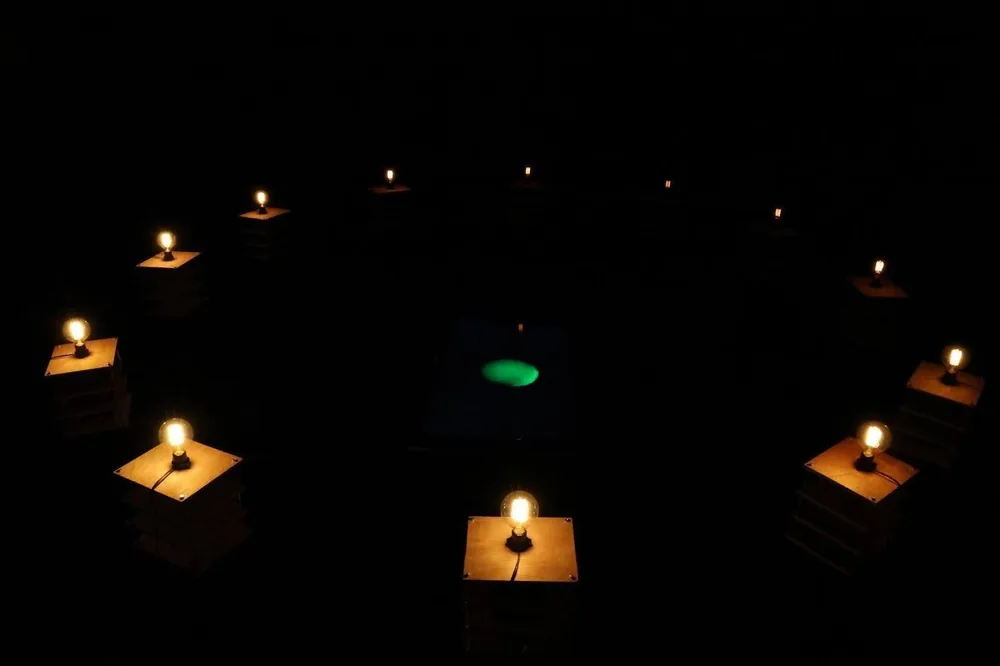
- poster
- Paper PDF link
- Presence: in person
- Type: long
- Session: Poster Session 2
Abstract:
This study proposes a compositional approach that draws on the biological phenomenon of Min waves, reaction-diffusion waves, generated within artificial cells. When cells divide, they initiate cell division through ripple-like patterns called “Min waves”. In the field of artificial cell engineering, researchers have successfully generated these waves within artificially constructed cells (artificial cells). Although cell division within artificial cells has not yet been achieved, the Min waves observed in artificial cells exhibit diverse behaviors under various conditions. In this study, we synthesize artificial cells that generate Min waves according to predefined chemical compositions, detect their dynamics, and explore how to integrate them into the structure and progression of artistic works. This study successfully developed a system for detecting the dynamic movements of Min waves generated in artificial cells through image analysis, allowing for the composition of a light-and-sound installation that directly integrates a quasi-lifeform into musical expression. Composers can construct the temporal and spatial development of light and music by modifying the synthesis conditions of the artificial cells, and intentionally design their dynamics. This compositional method utilizes the characteristics of Min waves generated in artificial cells to integrate the design of biological dynamics into the compositional process.