Feeling Connected: Designing Instruments and Haptic Feedback for Collaborative Music Exhibits
Paul Preuschoff; Karl Deilmann; Lea Schirp; Jan Borchers
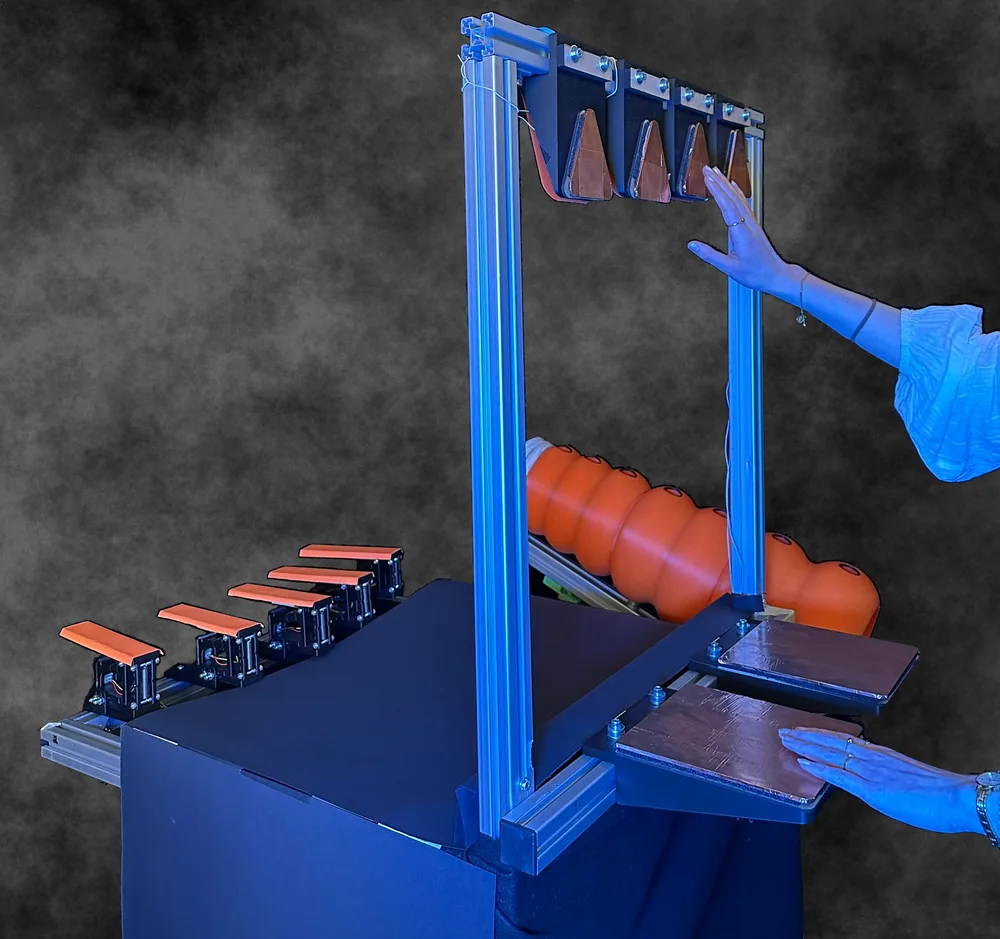
- poster
- Paper PDF link
- Presence: in person
- Type: medium
- Session: Poster Session 2
Abstract:
Walk-up music exhibits promise inclusive, social music-making, yet ad-hoc groups of novices often struggle to understand agency, coordinate timing, and stay aware of one another. To address this, we created an interactive exhibit for three visitors that features partially abstract instruments with distinct roles (Drums, Keys, and Bellow-Pipe) and multimodal feedback coupling audio with vibrotactile cues via floor plates and instrument-mounted actuators. Following a Research Through Design process, we conducted a participatory design workshop (n=7) that led to one of the instruments using a wind-instrument-inspired interface. A subsequent user study (n=21) of our refined system compared three haptic feedback modes during backing-track performances: a metronomic floor pulse, individual action feedback, and combined action feedback that merged co-players’ signals. Using observations, questionnaires, and reflexive thematic analysis of interviews, we found that groups transitioned rapidly from self-focused exploration to coordinated call-and-response play, reporting high levels of enjoyment and largely balanced participation. While participants consistently noticed the shared beat, perceived awareness of co-players increased over time. Haptic support was experienced as both guidance and potential overload: the metronomic pulse was seen as most helpful, whereas global feedback could increase group awareness but blur source separation. We discuss design implications for similar exhibits, highlighting trade-offs between scaffolding and freedom, individual clarity and group awareness, and feedback richness and perceptual load.