Feedback Sensibilities
Miguel Crozzoli (University of Iceland, Intelligent Instruments Lab)*; Stefanos Vasilakis (University of Iceland, Intelligent Instruments Lab)
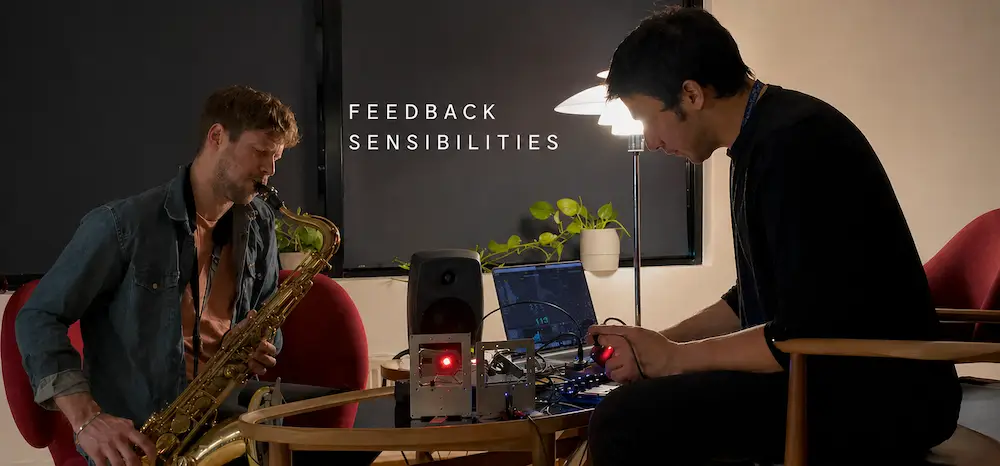
- Live Performance
- Paper PDF link
- Presence: In person
- Room Location: Rich Mix Studio
- Session: Concert 3
Abstract:
Feedback Sensibilities is a duo performance that explores textural complexity through the interaction of electronic and acoustic feedback instruments. The performance is developed through improvisation using a set of defined techniques for each instrument to structure the sonic possibilities as a method for composition. The instruments used for this performance are feedback saxophone and feedback circuit sniffers. The feedback saxophone is designed with a bell-mounted speaker and a two microphone configuration. The first microphone is positioned at the mouthpiece to provide frequency content and the second microphone is positioned at the bell capturing a chaotic complex feedback due to its proximity to the mounted speaker. The acoustic interaction with the feedback signal is based on extended techniques on the saxophone such as multiphonics and circular breathing. This instrument builds on the practice of John Butcher, informed by Greg Bruce’s research on post-digital feedback saxophone. Circuit sniffing is an extensively explored method in sonic art and NIME research by artists such as Christina Kubisch, Nicolas Collins and Andy Keep. This practice involves using coil inductors as probes to capture the fluctuations of the electromagnetic field (EMF) of electronic devices and transform them into sound. The circuit sniffing interface in Feedback Sensibilities utilizes circuit boards of multiple wireless optical computer mice as the source for the EMF to sound transformation. The sonic material captured by the sniffers serves as the excitation signal for a waveguide synthesis algorithm. By routing the synthesis output to physical coils, which are then re-captured by the inductors, the system establishes a closed feedback loop. In this performance, the sonic space is formed by maintaining a state of fragility between these two feedback instruments yet deriving in evolving textural soundscapes.