Choreographing the Way of Water: A Computational Framework for Aquatic Robotic Art
Aswin Karthik Ramachandran Venkatapathy; Christopher Golling; Sebastian Burmester; Noa Sendlhofer; Ruiheng Jiang; Jan Kamm; Raffaello D'Andrea
- oral
- Paper PDF link
- Presence: in person
- Duration: 13
- Type: medium
- Session: Embodying
Abstract:
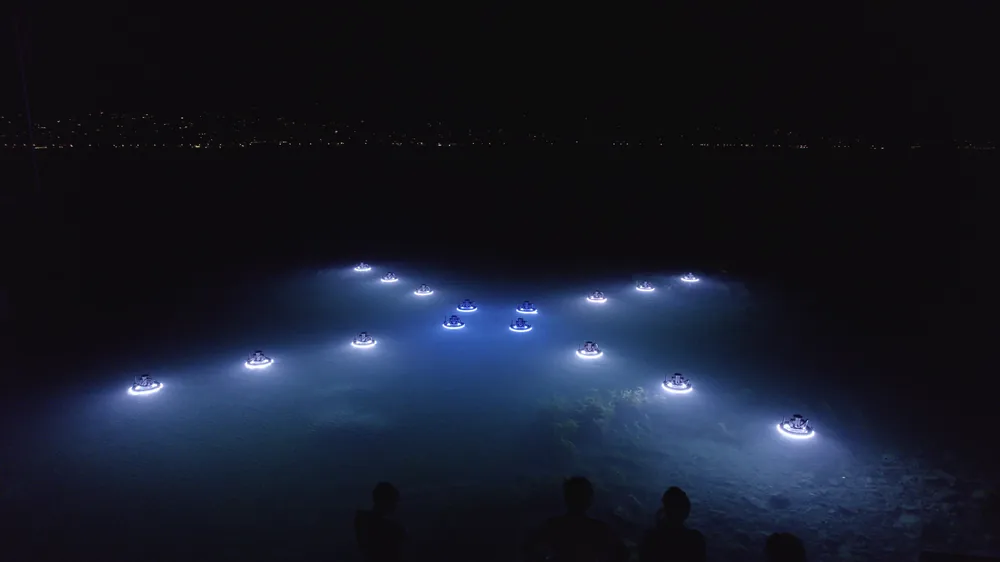
Robotic choreography in open water is governed by nonlinear fluid dynamics, which impose significant challenges due to environmental disturbances and nonlinear system dynamics. This paper presents the cyber-physical architecture of Way of Water, a vertically integrated framework that orchestrates a fleet of autonomous surface vessels as a distributed choreographic platform. Moving beyond the surface-pixel paradigm, these vessels use laminar nozzles and multi-zone lighting to extend their expressive range from the 2D water plane into the 3D volumetric domain. Our primary contribution is the Way of Water Studio, a browser-based, timeline-compositing authoring paradigm that treats the fleet as a DAW-like instrument for music-responsive choreography. The Studio encapsulates Sequential Convex Programming for trajectory generation and Model Predictive Control for disturbance rejection, presented through a visual timeline, broadening access to high-performance aquatic robotics for non-programmer artists. Grounding the Studio is the full cyber-physical stack: a custom holonomic chassis, a state-estimation and control stack tuned for the aquatic domain, and an LTE/MQTT fleet link with RTK-GPS time synchronization. We report on the system’s validation across two distinct deployments: an 18-vessel Swan Lake interpretation at Lake Zurich and an 8-vessel Time Space Existence 2025 Venice Biennale demonstration at Forte Marghera, establishing a foundational reference for the design and deployment of fluidic robotic swarms.