Sustained Interests: Lorentz Time Division Multiplexing (LTDM) for Active Collocated String Control
Adam Schmidt; Andrew McPherson
- oral
- Paper PDF link
- Presence: in person
- Duration: 16
- Type: long
- Session: Sensing and Actuating
Abstract:
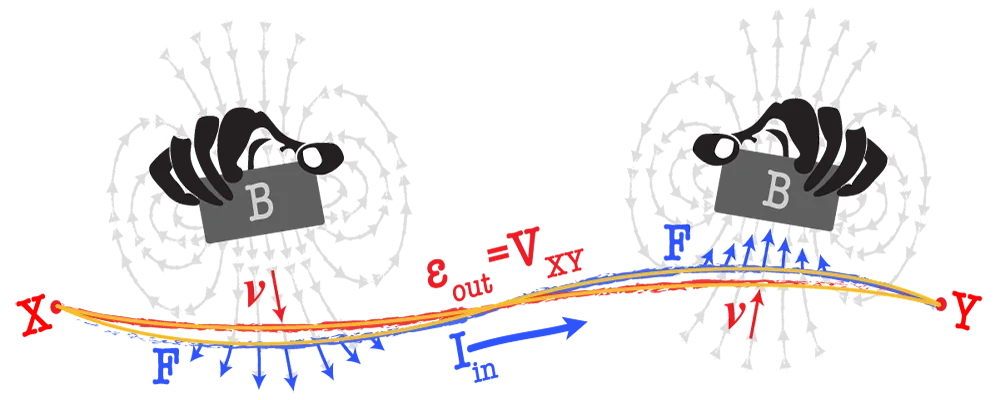
This work introduces Lorentz Time Division Multiplexing (LTDM), a technology that actively sustains vibrations on conductive instrument strings by exploiting the inherent bilateral nature of electromagnetism. Though many feedback instruments depend on using separate, external sensors and actuators to monitor and induce vibrations in a string, our LTDM controller initiates and sustains vibrations by running electric current through the string itself. By connecting custom circuitry to a conductive string via two electrical leads, strings vibrate and self-sustain when a permanent magnet is held or fixed in close proximity without the need for external sensors or actuators. Unlike most feedback instrument methods to date, the inherently collocated nature of LTDM affords coherent control without specialized calibration and can be easily deployed from instrument to instrument with minimally invasive augmentation. A pair of contrasting case studies demonstrate some of these new sonic qualities and playing techniques we have observed thus far from the same metallic strings musicians have used for centuries.