Workshop on Haptic Musical Artifacts: Availability, Replicability, Sustainability of Force-Feedback Devices
Christian Frisson (University of Calgary)*; Marcelo M. Wanderley (McGill University)
- The registration for this workshop is managed by the workshop organisers. Please check the workshop's website page for more information
- Type: In person
- Room Location: LDN 2.07
- Session: Workshops Morning
- Morning (9am-1pm)
- Signup Deadline: May 29th AoE
- Contact Email: here
Abstract:
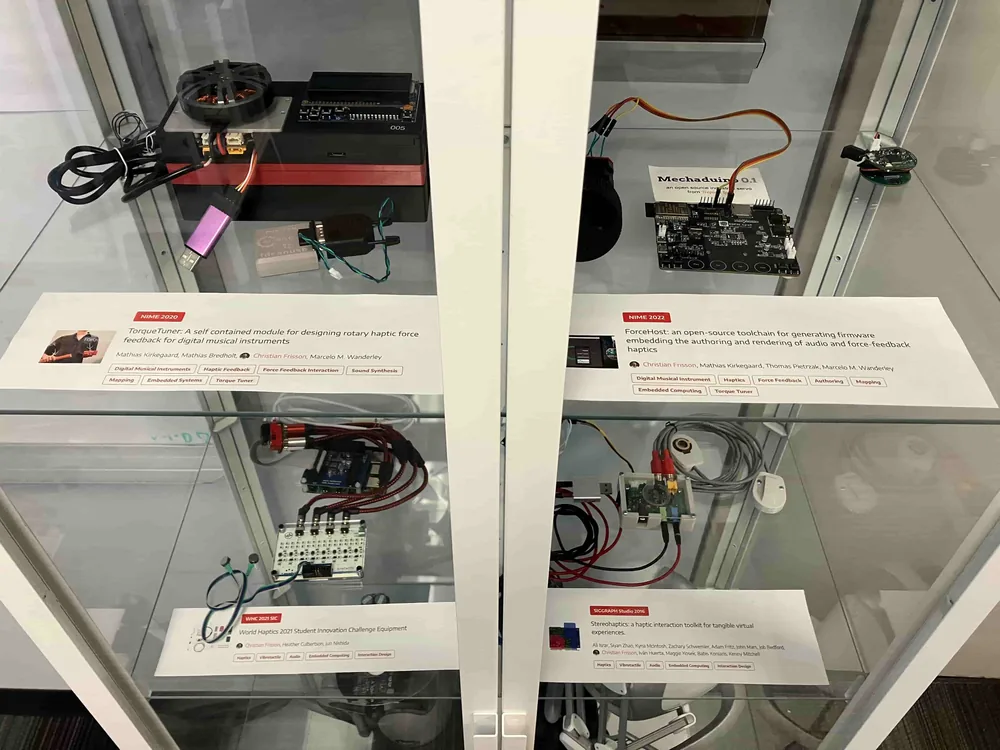
Haptics has been a NIME topic right from the start: word stem ‘haptic’ was mentioned in NIME’01 workshop papers, and then part of a publication title for the first time at NIME’02, the first NIME conference!, while NIME keynote presenters focused or discussed HMA on several occasions (e.g. 2003, 2013, 2015 [7] & 2019). There are 49 occurrences of the word “haptic” in titles and 84 in abstracts for NIME paper proceedings up to 2025, as searchable in the github repository versioning the NIME bibliography.
Though common in NIME, Haptic Musical Artifacts (HMA) can only be experienced in person. With the exception of a few sub-categories of haptic hardware that are widely deployed, for instance, vibrotactile haptics in mobile phones, most HMA remain confined to research labs. Force-Feedback devices, on the other hand, are much less available to the NIME community. They tend to be expensive and demand hardware and software specifications which are not straightforward to implement. Furthermore, these devices become rapidly obsolete as computer hardware and software evolve, making them even less accessible. Finally, the applicability of such devices is not evident due to proprietary protocols (firmware, drives, etc.) and the unavailability of original electronic circuits. All these issues have a decisive negative impact on the sustainability of haptic research in NIME and elsewhere, with most projects having a lifespan of a few years (typically the duration of a PhD thesis).
This workshop aims to present a retrospective review of HMA, specifically, force-feedback devices used in musical applications, accompanied by hands-on demonstrations, to provide NIME attendees with an opportunity to revisit and experience research on haptics and music. Furthermore, a general discussion will be held on ways to create a consortium of researchers interested in the replicability and sustainability of HMA within the NIME community.
Worshop website: https://nime2026hma.github.io/