Satie: A Creativity Support Tool for Authoring Spatial Generative Audio
Mateo Larrea; Richard Boulanger; Yuhao Zhang; Jerry Chen; Pedro Sodre
- poster
- Paper PDF link
- Presence: in person
- Type: medium
- Session: Poster Session 3
Abstract:
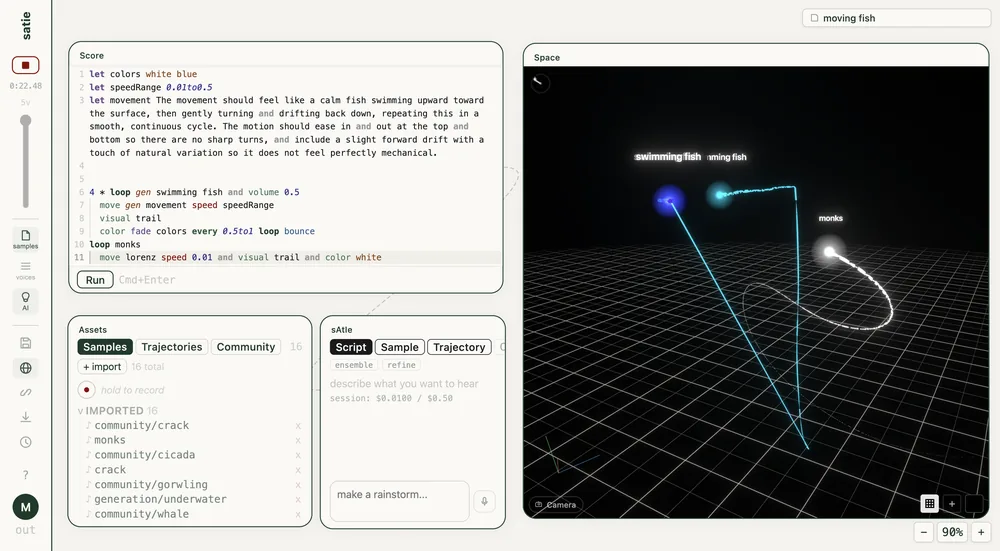
Composers and sound designers working in immersive spatial audio often face a gap between creative intent and implementation. Core behaviors such as stochastic timing, per-event parameter variation, and smooth 3D motion are conceptually simple but require substantial programming in a game engine or DAW. Generative AI can help: large language models can produce code, and audio-generation models can synthesize material from text prompts. However, these outputs are often opaque and difficult to revise. We present Satie, a creativity support tool that lets designers use generative AI while retaining authorship. Satie is built around an audio-first domain-specific language whose keywords reflect sound design vocabulary (e.g., volume, pitch, fade, move fly). The language is plain text with a line-per-property structure, acting as a shared interface between the designer and AI: an LLM can generate Satie code, the runtime can generate audio from embedded text prompts via the gen keyword, and the same mechanism can define procedural spatial motion. Designers can read, understand, and modify individual properties without unintended side effects. Satie runs as an interpreted layer in a web application using the Web Audio API, supporting live editing and real-time visualization of sound trajectories. Sketches can be saved, forked, and shared, and gen statements resolve against a community sample library before falling back to synthesis. We demonstrate Satie through immersive scenes, compositions, and live coding scripts, and evaluate expressivity through code comparisons and informal designer feedback.